INDUSTRYINCLUSIVITY
Breaking Down Barriers
How my daughter’s neurodiversity inspired me to offer inclusivity training
KATIE THATCHER
Buckingham-based beauty pro with autism & founder of Katie Thatcher Training & Consultancy
www.katiethatchertrainingandconsultancy.com
@katie_thatcher_consultancy
Katie Thatcher Consultancy
Nail techs share how they navigate challenges to flourish in their careers
Six years ago, I didn’t know much about neurodiversity – and I certainly didn’t recognise it in myself or those around me. Then, at a parents evening for my daughter, a teacher told me she was ‘not the brightest’ and ‘one of the slowest readers in the class’.
This made me angry, not only because the comments weren’t reflective of who my daughter really is, but because the staff didn’t put forward any plans to support her.
I proceeded to conduct my own research, and had my daughter assessed for dyslexia. At 10 years old, she was diagnosed, as well as with behavioural optometry problems. She has visual disturbances, which affect her sight and make it difficult for her to read black writing on a white background.
This was when my passion for neurodiversity support began. Around this time, my nephew was diagnosed with ADHD and autism, which inspired me to do more research so that I could help him. Now, all three of my children have been diagnosed with ADHD and/or autism.
I started to think about how many people were overlooked at school and now walking through my salon door, and how they might cope with day-to-day life as adults. I knew that if my daughter visited a salon and was handed a white consultation form (whether on paper or digital), she would struggle to read it and feel uncomfortable and embarrassed. These aren’t feelings you want your clients to feel.
I also thought about how many people would love to go to a salon, but don’t because they might feel uncomfortable. From a business perspective, how many clients are you losing out on because they assume you won’t understand their needs?
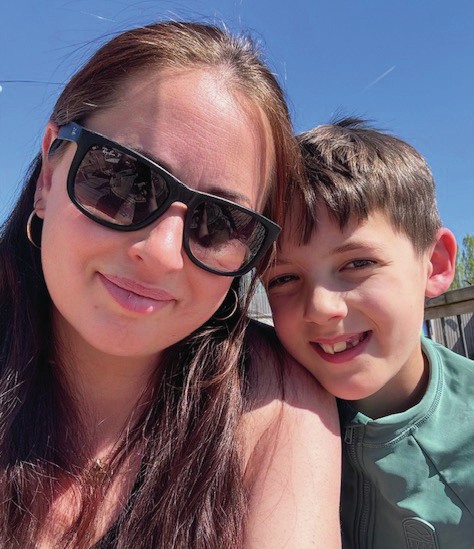
With my youngest
son, who has ADHD.
Off the back of my research and experiences in the beauty industry and adult education, I decided to do something about the fact that, unintentionally, many salon and spa environments are not comfortable places for neurodivergent clients. Last year, I launched Katie Thatcher Training & Consultancy to help other business owners and salon/spa teams better understand conditions such as ADHD, dyslexia and autism.
I have created short course material covering a variety of topics, including ‘Be clued up on neurodivergence’ and ‘Understanding and supporting dyslexia in your salon’. This is available via my website. Last month, I launched bespoke training for nail techs who require a neuroinclusive education setting. Often, people assume this means one-to-one learning, but this can be a terrifying idea to some. If students want to bring a friend or parent, they can.
‘‘ Neurodiversity is everywhere; we just need to work on normalising it, and that comes with conversations. ‘‘
Neuroinclusivity notes
1. Educate yourself. Statistically, you will employ neurodivergent team members and serve neurodiverse clients. If you make your space and services appealing to those who are neurodivergent, you open up your business to a wider group of people and ensure everyone is comfortable.
2. Open up the conversation. I always say: ‘normalise what’s normal’. In many of my conversations with clients, I mention something about one of my children and an hour later, the client is still chatting to me about a neurodivergent family member or friend. Neurodiversity is everywhere; we just need to work on normalising it, and that comes with conversations.
3. Consider your environment. While your salon may be designed to feel like a place of relaxation and escapism, this might not always be how a neurodivergent client sees it. Sensory issues are a big problem for some: music can be a trigger for anxiety and smells might make people feel nauseous. Where possible, offer clients a choice. For example, white noise can be a great music alternative – and consider fake candles and plants, so you get the effect without the smell.