FUNGI: the facts
Industry expert, Vitaly Solomonov, interviews microbiologist, Dr. Philip Geis, about microbial myths, foot fungus & how nail pros can ensure safety

Vitaly Solomonov

Dr. Philip Geis
About Philip Geis
Dr. Philip Geis has been a microbiologist for more than four decades. His expertise lies in microbiological safety and product quality. After earning a doctorate in Microbiology, he managed clinical microbiology operations in the United States Army, where his work earned him the
Army Commendation Medal.
Later, at Procter & Gamble (P&G), he led global initiatives on preservative development, disinfectant innovation and studying the microbiological ecosystems of skin and household environments. In recognition of his work, P&G established the Dr. Philip Geis Product Quality Award, with Geis as the first recipient.
He serves as editor of book, Cosmetic Microbiology: A Practical Approach, and journal, International Biodeterioration Biodegradation.
What are the biggest misconceptions about skin and nail microbes/microorganisms?
Philip: Not everyone realises that antimicrobial products have limitations. Soaps and some disinfectant solutions can become contaminated, and even alcohol products may contain surviving bacteria. For this reason, solutions should be prepared and replaced as recommended. No antimicrobial product removes every microbe from the skin or nails. They generally work best after thoroughly washing the hands or feet with soap, or using a suitable cleanser.
UV is often mistakenly thought to sterilise equipment. In practice, it only works on surfaces directly exposed to the correct type and dose of UV light, so hidden areas may remain untreated.
The concept of ‘microbiome’ has become popular in beauty marketing, but how much of this is scientifically sound?
Philip: The microbiome refers to the community of bacteria, fungi and other microbes that live in and on our bodies. These microbes have evolved alongside us for so long that they are considered part of our natural biology.
Marketing hype – from ‘microbiome-friendly’ to probiotic cosmetics – has made the term meaningless. One cosmetics brand even claims to re-establish a microbe that humans lost long ago.
Would you say the foot is one of the most microbiologically ‘loaded’ areas of the human body?
Philip: Feet generally have a significant microbial load, especially between toes. Foot odour is an indirect indicator of a large microbe population.
There is a noticeable rise in fungal infections – to what can this be attributed?
Philip: Some fungi have become increasingly resistant to treatment, while more people now have weakened immune systems, often due to medical conditions. Diagnosis has also improved, making fungal infections easier to detect and identify.
Can fungal infections of the feet or nails remain symptom-free for an extended period?
Philip: Yes, I’m confident that’s true. Symptoms depend not only on the type of fungus, but the person’s health and conditions such as moisture and how enclosed the feet are. Once established, a fungal infection can be long-lasting. Symptoms may come and go, but when they return, they may not be the result of a new infection. The fungus may have remained present and become more noticeable when the body is less able to keep it under control.
‘‘ Nail professionals are often well-placed to spot any changes in the feet early – and should encourage clients to seek medical advice before a problem becomes more serious. ‘‘
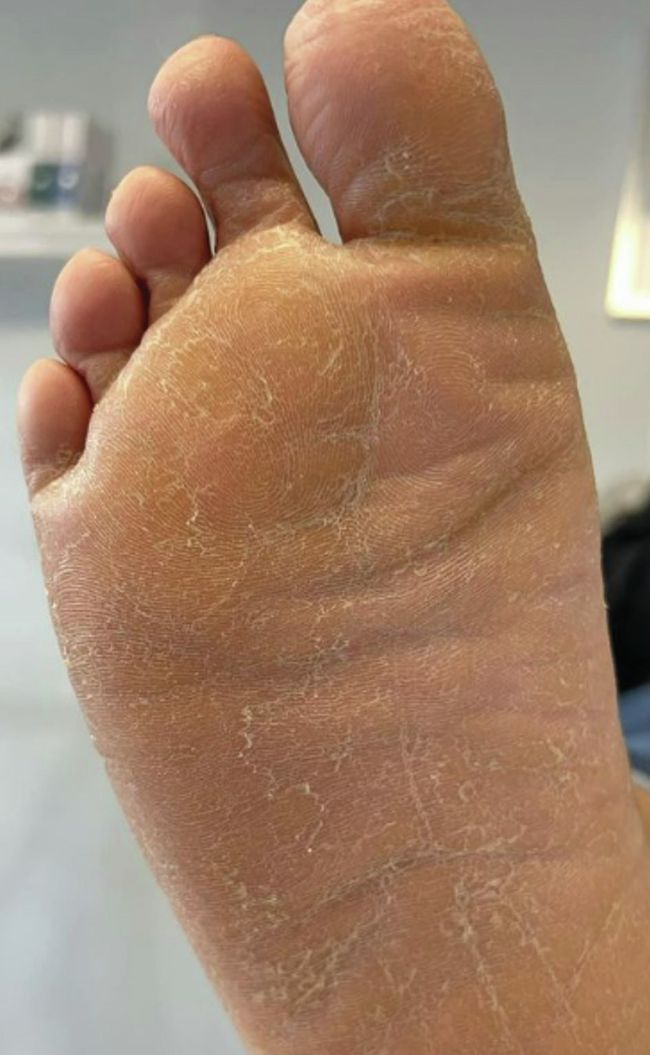
If a client’s feet have very dry skin, it could be a sign of a fungal skin infection – a precursor to nail fungus.
Why do many footcare professionals report that when they file the skin of asymptomatically infected feet, they sometimes experience facial or scalp irritation?
Philip: There’s always a risk of infection from exposure to skin flakes from infected individuals. This usually requires some physical breach of skin or nail damage, and fungal infections of the face or scalp may be more common in people with weakened immune systems.
The footcare industry often divides into two groups: those favouring the water-based pedicure and those who prefer the waterless/dry pedicure. From a microbiological standpoint, which method is preferable?
Philip: The dry pedicure is microbiologically safer. Water contains bacteria, potentially including
Pseudomonas aeruginosa, which causes ‘greenies’ and other infectious inflammatory conditions.
How do you view the role of nail professionals in preventing bacterial and fungal infections?
Philip: Preventing infection is essential, and good hygiene is the starting point. Where possible, sterilise tools to offer the greatest level of protection. Implements should then be dried and stored covered. It’s worth noting that true sterility is not achievable.
Water can also introduce microbes, such as when rinsing disinfected tools. Therefore, foot baths and basins require thorough cleaning, and any solutions used in water should be freshly prepared.
Prevention is only part of the picture. Many people do not routinely see a healthcare professional about their feet, and may only seek help when symptoms become uncomfortable or obvious. Nail professionals are often well-placed to spot any changes in the feet early – and should encourage clients to seek medical advice before a problem becomes more serious.
‘‘Preventing infection is essential, and good hygiene is the starting point. Where possible, sterilise tools to offer the greatest level of protection. ‘‘