INDUSTRY INCLUSIVITY
Breaking Down Barriers
Autism in the nail industry: impacts & adaptations
RIKKI QUINN
Newcastle nail pro with autism and ADHD & owner of sensory-friendly salon, Glitching Beauty
@glitchingbeauty
Glitching Beauty
@glitchingbeautyuk
Nail techs share how they navigate challenges to flourish in their careers
Autism fact file
April is World Autism Acceptance Month: an annual initiative dedicated to raising awareness, promoting understanding and garnering support for the autistic community. A range of online and in-person opportunities are planned for this month, for both individuals and businesses.
According to UK charity, National Autistic Society, more than one in 100 people are autistic. The organisation provides support and guidance to autistic people and their families, and campaigns for improved rights, services and opportunities. Its website states: “Autism influences how people experience and interact with the world. It is a lifelong neurodivergence and disability. Autistic people can be very different to each other, with different sets of strengths and challenges.”
The charity shares that the core characteristics of autism needed to receive a diagnosis are ‘lifelong differences in communication, behaviours and interests compared to non-autistic people’. Differences in communication may affect how words, tone and body language are understood, and alternative methods of communication may be used. Variations in behaviours and interests may present as focused interests, repeated movements, preference for order and impacted sensory processing.
www.autism.org.uk
@nationalautisticsociety
/NationalAutisticSociety
Join the National Autistic Society’s online community by visiting community.autism.org.uk
Istarted my business after looking for a nail space that catered to mine and my peers’ needs. I couldn’t find one that felt comfortable, calm and genuinely inclusive, so I built it myself. I only recently realised, when I was diagnosed with autism, that a lot of the measures I’d put in place were because of my neurodivergence. I set out to create a space that felt safe and sustainable – and it turns out that when you do that honestly, it can help a lot more people than you might expect.
Autism affects my working day in both challenging and brilliant ways. Sensory overload has a big impact, and sound, bright lighting and strong smells can overstimulate me quicker than many people realise. This is why I don’t offer L&P acrylic services, as the smell can be overwhelming. I also have limited social energy, even on a good day. Although I offer low-chat and quiet appointments, interaction is still interaction. It takes energy to hold space for people, to listen and to respond. Add unpredictability into the mix, such as last-minute cancellations, sudden design changes or shifts in routine, and my nervous system can get frazzled.
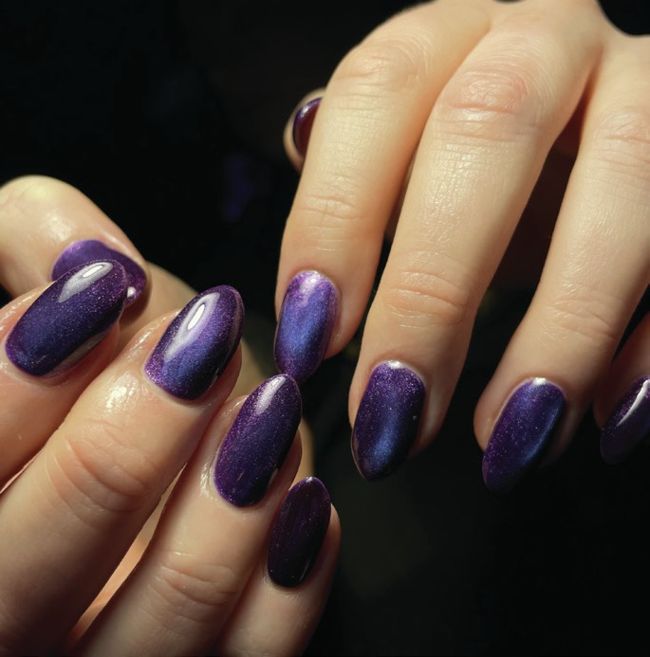
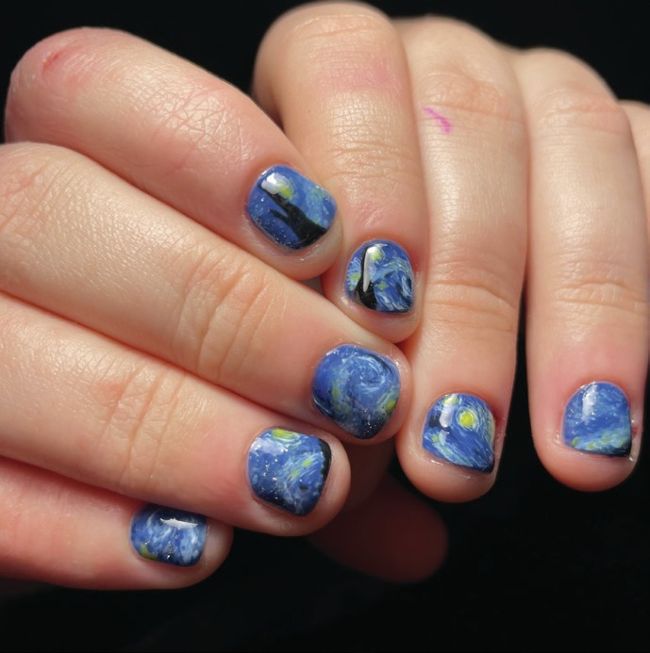
But it’s not all a struggle. My attention to detail is amazing. When I hyperfocus, I will perfect the tiniest line, the smoothest product application and the crispest cuticle work. The same brain that gets overwhelmed by chaos can lock in like a laser when it’s time to create. That’s a gift.

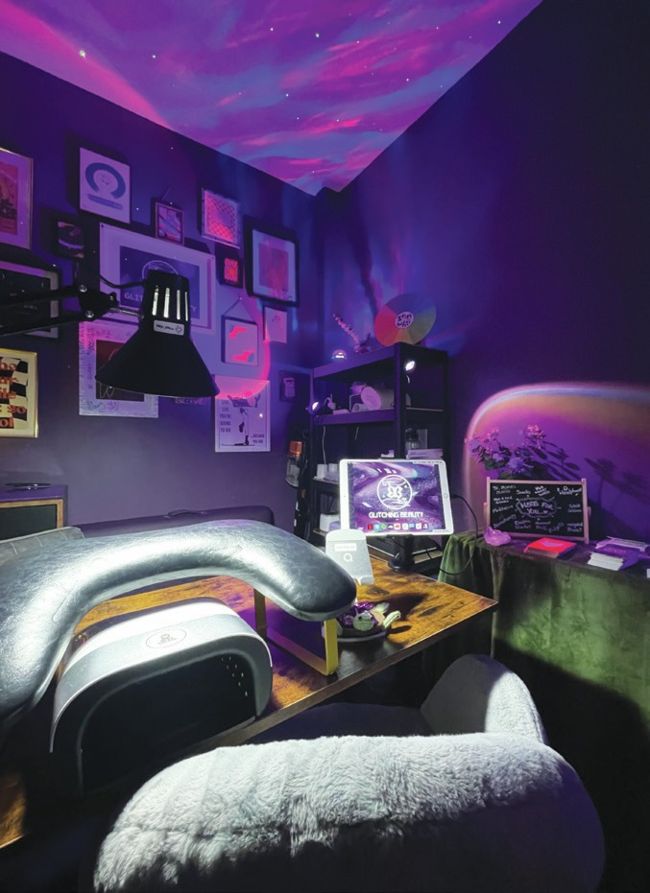
My studio was designed not just for my ideal clients, but for me. It features low lighting, soft furnishings, weighted accessories, fidget toys, comfort items and earplugs, and has a cosy, calming feel. It’s set up to either stimulate or soothe, depending on what is needed. Snacks, drinks and blankets are available, and clients can choose how hot or cold they would like the space. They are in charge of the Glitching Beauty iPad and can opt to play music or watch something. These adaptations are simple, but they send a big message: you’re allowed to have needs here. What’s lovely is that this is mirrored back to me. If I need a small adjustment, my clients are so understanding. That mutual acceptance is very meaningful.
‘‘When you design something that respects your own nervous system, you’re not just building a business – you’re laying the groundwork for an entire community to thrive.‘‘
Burnout has been a recurring theme in my life. In traditional employment, I felt pressure to push through and keep performing, so being self-employed has been a game changer. I can be flexible with my hours, and last year, I started allocating proper breaks between appointments. I realised that I was hyperfocusing so hard that I was forgetting to eat or move. This could quickly lead to meltdowns. Now, small gaps between bookings allow me to regulate, hydrate and let my brain reset. They have also made appointments clearer and more predictable for clients, and allowed me to add services for people who struggle with sitting for long periods.
For new clients, I always do a slow and clear introduction. I explain my intentions for the space, what support is available and exactly how the appointment will run. Predictability matters. My booking system is intentionally simple; clients don’t need to know nail terminology.
They just book the two-hour ‘Nails & Wellness Session’ and we figure out the details together. Each appointment has a set structure and timeframe, which allows space for stimming, regulation breaks and breathing exercises.
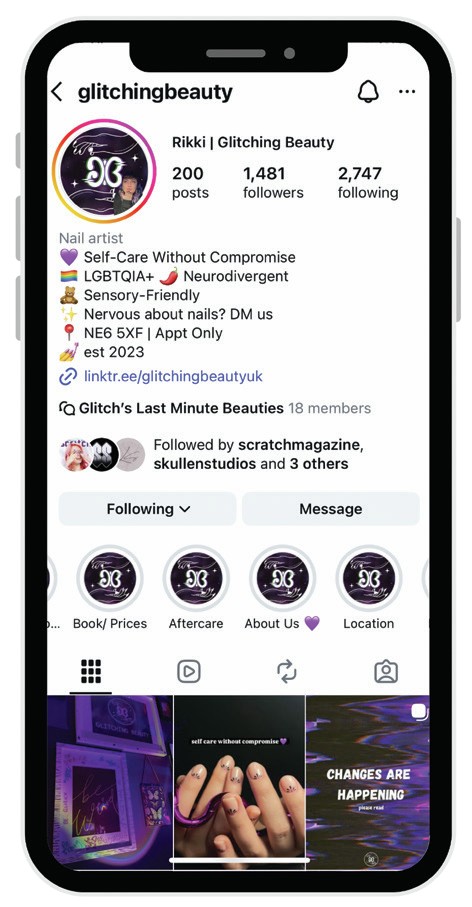
The Glitching Beauty can familiarise themselves Instagram page.
Online, I try to mirror that clarity online. My Instagram Highlights include clear pricing information, directions to the salon, parking details and photos of the studio and facilities, so clients before they arrive. Pre-planning massively reduces an autistic person’s anxiety. Small adjustments like these can be the difference between someone booking or not. I’ve also started collaborating with local businesses to help them consider sensory offerings, because autistic needs are often ignored.
It’s always been my dream for Glitching Beauty to grow into a multi-service studio, featuring other creatives with aligned values. I’ve imagined a shared space where different services are built around accessibility, sensory awareness and inclusivity: a place where creativity and care sit in the same room. When you design something that respects your own nervous system, you’re not just building a business – you’re laying the groundwork for an entire community to thrive. The beauty industry is slowly recognising different sensory needs, but I believe that nail spaces have a lot of catching up to do.
Tips for autistic nail pros
My advice is simple: build your business around your needs. If something consistently dysregulates you, don’t tolerate it – redesign it, and embed the adaptation into your model. You’re not the only one struggling, so find your community. Online peer groups and autistic-led spaces are full of people sharing ideas, problem solving and supporting each other.
For formal support, the NHS and private psychologists can guide you through assessment and diagnosis pathways, and the National Autistic Society offers guidance, resources and support groups.