ECOMATTERS
Planet-positive POINTERS
Scratch marks Earth Month by sourcing expert advice & handy products for making your nail business more eco-friendly
ALEX FOX REPORTS
April marks
Earth Month
: a 30-day window that reminds us of the responsibilities we share by living on planet Earth. We’re in an era where waste, be it household or business, is an issue that most people are aware of and take steps to reduce. But are we doing enough?
The more we innovate, the more we need to do to protect the environment. It may seem that one person or business can’t make much of a difference, however collective small steps equal giant leaps.
Nail businesses, whatever their size, can do their bit to help – and it’s vital that they do. The British Beauty Council cites: “95% of beauty packaging is thrown away and only about 9% is recycled.” However, the largest waste category for nail businesses is disposable files and wipes – a shocking thought if you consider the amount used in an average workday. Using single-use files could equate to around 1,600 files discarded per client, per year. Waste is also created from gloves, as well as nail product bottles, which often end up in landfill as many recycling centres reject the small containers.
If you’re ready to make your nail business more eco-friendly, we’ve rounded up advice from inspiring pros and salon owners, and spotlighted brands and organisations to support your sustainability journey. Why not use this month to introduce green practices into your business? If you do, be sure to shout about it – whether to clients, via local media or online. Only through these conversations can we afford real change.
CASE STUDY: eco-conscious enterprise
Scratch
discusses sustainability with Coreen Flaherty, director of Cheshire salon, Finishing Touch Hair & Beauty...

Coreen Flaherty
What does sustainability mean to you and your business?
“It means making thoughtful choices every day: reducing waste, using smarter products and caring for our clients without compromising the future. It’s about progress, not perfection.”
Why is sustainability important to you personally and professionally?
“After nearly three decades in the beauty industry, our team feels a responsibility to lead by example. Personally, we want to protect the world our families live in and professionally, we want to run a responsible salon that clients feel good supporting.”
What practical measures have you implemented to reduce your environmental impact?
“We’ve reduced single-use plastics, are mindful of energy and water use, and have introduced Enki disposable towels. The last measure is a simple switch that has helped us improve hygiene, while cutting down on laundry, water and energy use.”
What are the easiest environmental improvements salons can make?
“Introducing reusable towels, not wasting water, purchasing in bulk and separating waste better. These changes save money over time and are easy to implement.”
Where do you feel that more support is needed?
“Clear guidance on sustainable standards and practical incentives for small salons would help enormously – particularly regarding waste, recycling and supplier transparency.”
www.finishingtouchhairandbeauty.co.uk @finishingtouchhairandbeauty
‘‘The largest waste category for nail businesses is disposable files and wipes. Using single-use files could equate to around 1,600 files discarded per client, per year. ‘‘
ECO-THINKING TECHS
Emily Sims
@em_28_charned Emily Sims of Em’s Nails & Beauty, Aldridge, is combatting the quantity of wipes she uses in a working day with homemade fabric pads. “My mum made the pads from an old skirt and towel,” she says. “They took her less than 20-minutes to make, and are laundered at the end of each day.
“I believe the key to sustainability is using high-quality tools, such as those from Katie Barnes Tool Range, with care. If you look after your tools, they will work more efficiently and last longer,” she continues. “I also recycle as much as possible and upcycle pots, in which I store salon essentials.”
Jodie Whitehead-Booth
www.botella.uk @botellauk
Salon owner, Jodie Whitehead-Booth, is co-founder of Botella, a brand that creates sustainable glass acetone and lotion bottles for nail pros. “Before Botella, I’d already started stripping things back. I downsized my salon premises to cut operating costs and help with rising energy bills,” Jodie shares. “I knew the move wasn’t going to be cheap, so I made a decision: if I was rebuilding, I was going to do it properly.
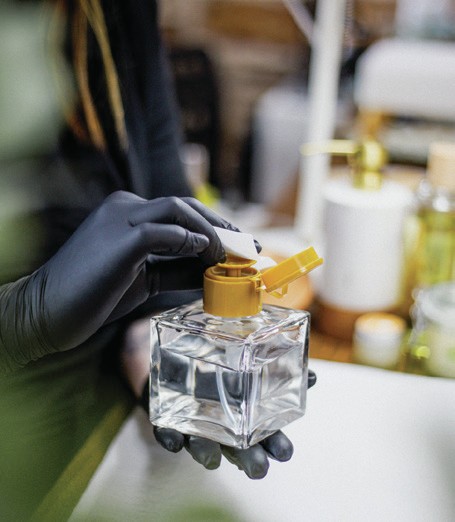
“I built nail stations from reclaimed scaffolding boards and sourced pre-loved furniture, which I upcycled. But when adding finishing touches, my plastic acetone bottles did not fit the vibe or intention – especially those that had melted. I’d gone to the effort of reducing overheads and energy use, and rethinking how I operated, but the products I used were built around convenience and disposal. This frustration was the beginning of Botella. I created 200ml glass pump bottles to store nail product liquids such as IPA, acetone and nail prep fluids. Their twist-lock lids ensure a secure seal, minimising the risk of leaks and protecting from overexposure.”
Amy Lambourne
@amylambournenaturalnailtech
Amy Lambourne of Mortimer, Berkshire, uses a simple yet effective method to reduce waste. “I retail CND SolarOil™ for £3
(3.7ml), £9.95 (7.3ml) and £15.95 (15ml), but buy large bottles of the product for refills. I charge £2, £7 and £12 for refills of the different sizes. This is a win-win situation for myself and clients, and reduces packaging waste.”
‘‘Nail businesses, whatever their size, can do their bit to help – and it’s vital that they do.‘‘
Sarah Morris
CASE STUDY: Eco-conscious enterprise
Scratch
puts the spotlight on Shrewsbury salon, Meraki Hair & Beauty, by speaking to owner, Sarah Morris...
What does sustainability mean to you and your business?
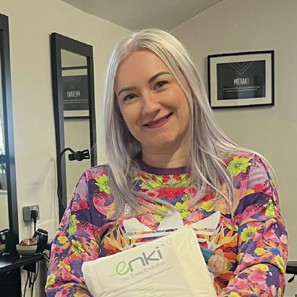
“Sustainability is something we think about in the small, everyday decisions we make. For us, it isn’t about one big change – it’s about making thoughtful choices that, over time, create a positive difference.”
What practical measures have you implemented to reduce your environmental impact?
“We’ve switched to Enki disposable towels. Traditional salon towels require large amounts of water, electricity and detergent to wash and dry, whereas Enki towels are made from biodegradable, plant-based fibres and are fully compostable. We also carefully separate our waste and have stopped printing paper price lists. Instead, we display our service menu in the salon and encourage clients to take a photo of it.”
www.merakihairbeauty.co.uk
@merakihair_shrewsbury
Enki Luxury Single-use Hand & Face Towels from £14.95 + VAT www.enkitowels.com
Organisations to note
Green Salon Collective Founded by environmental experts, Green Salon Collective has saved 200 tonnes of salon waste from landfill to date, and works to create a circular economy. It converts waste into useful items: its most powerful example being the repurpose of hair for 10 different uses, including clothing, yarn and mats to absorb pollutants in waterways. In its General Waste to Energy scheme, it harnesses materials like plastic, food, foils, contaminated salon towels, wax strips, cotton buds, PPE and wet wipes to produce energy. www.greensaloncollective.com
The Sustainable Beauty Coalition (SBC) Working alongside the UK government, the British Beauty Council’s Sustainable Beauty Coalition is a united taskforce of industry professionals dedicated to an eco-conscious beauty sector. From championing recycling, refill and reuse models to highlighting best practices though its Planet Positive Beauty Guide and organising annual campaign, the Great British Beauty Clean Up, the Coalition has a wealth of resources and opportunities to support sustainability. www.britishbeautycouncil.com/sustainable-beauty-coalition Scan to read the Planet Positive Beauty Guide.

Lucy Allen
CASE STUDY: Eco-conscious enterprise
The four-strong team at Offbeat Beauty Collective (OBC) in Sheffield: Lucy, Nico, Lucie and Sira, are united by their neurodivergence, passion, creativity and commitment to sustainable practices. Founder, Lucy Allen, shares insight...
Why is sustainability important to you personally and professionally? “Sustainability starts at home for me. I live on an eco-housing development; run my house on a reduce, reuse, recycle basis; drive an electric vehicle, and my husband and I are vegan. It’s not about perfection – it’s about doing what you can: ‘imperfect action over perfect inaction’. OBC is my way of proving that you can run a successful, inclusive business without selling out your values.”
What practical measures have you implemented to reduce your environmental impact?
“We tackle sustainability from all angles:
• Eco Offset scheme: We’ve planted 10 trees and retired 10 Verified Emission Reductions (VERs) via a solar project in India, saving 10 tonnes of CO2.
• Waste reduction: We use compostable towels, reusable silicone soak-off caps, and refillable and recyclable cleaning products like OceanSaver, Miniml and Salvesan. We also bulk-buy essentials, avoid single-use plastics where possible and reuse empty gel pots for mixing custom colours.
• Product choices: We only use vegan, cruelty-free and eco-friendly brands, and retail cuticle oils in glass bottles. Even our enzyme cleaner for tools and hypochlorous acid disinfectant are planet-friendly.
• Energy: Our salon is low-energy, with LED lighting and low-energy equipment and appliances, and we know our usage because we’re on our own meter. In Sheffield, our non-recyclable waste goes to an energy recovery facility, powering and heating homes.
• Supply chain: As a self-employed team of professionals, we try to consolidate our product orders. This way, we’re all responsible for buying our own products, but reduce packaging, carbon emissions and delivery costs.”
What has been your biggest sustainability challenge?
“Sourcing genuinely ethical products and battling greenwashing (when a business pretends to be more environmentally friendly than it is). Cost can be an issue too, as eco-friendly options tend to be pricier and harder to find, but this is transparently factored into our service prices.”
How do you reduce your carbon footprint?
“We offset our projected salon emissions with tree planting and renewable energy projects via the Eco Offset scheme. Salons with a local authority that doesn’t have energy recovery facilities can track and reduce their carbon footprints via Green Salon Collective. The organisation offers recycling programmes and General Waste to Energy bin collections for non-recyclable items such as PPE and contaminated waste like empty gel polish bottles.”
What does a ‘carbon neutral salon’ mean to you, and is it a realistic goal for the nail industry?
“It means measuring, reducing and offsetting impact. With organisations like Green Salon Collective, it’s totally achievable – but these companies need more support and visibility. The nail industry could dramatically reduce its carbon footprint by ditching excess packaging, switching to compostable or recyclable shipping materials and consolidating shipments. Sourcing locally, bulk-buying and offering refill options will also help cut down on transport emissions and waste.”
If you could design the nail salon of the future with sustainability at its core, what would it look like?
“It would be a 100% renewable-powered salon, with air source heat pumps for heating and hot water, refill stations and only plant-based, compostable or reusable tools and products. In an ideal world, local authorities would run energy recovery schemes for all non-recyclable items.”
www.offbeatbeautyco.uk @offbeat_beauty_collective
Product pick
LP Nails’ Metal Boomerang Base Plate, in conjunction with the brand’s Replacement Nail Files, delivers a hygienic, efficient filing solution. With the replacement files available in 100, 150 and 180-grit, and able to stick to and peel off the base plate, the system offers a simple way to reduce waste and is a cost-effective solution to having a new nail file for each client.
Purchase the Base Plate and Replacement Files via www.lpnails.com

Inês Ferreira
BRAND MOVES
Andreia Professional
Portuguese hair, make-up and nail brand, Andreia Professional, sees sustainability as an essential part of its ethos.
Inês Ferreira, the brand’s quality assurance & regulatory affairs officer, shares: “From formulation to production, every brand decision is made to deliver high-quality results, while being vegan, cruelty-free and as clean as possible. We eliminate unnecessary ingredients and reduce waste through recyclable packaging. For professionals, this means no trade-offs: beautiful, long-lasting results with a lighter footprint.”
Inês continues: “Andreia Professional is carbon neutral and actively supports environmental programmes, including the conservation of the Amazon Rainforest through a partnership with carbonfund.org. In Portugal, we have planted over 500 trees in collaboration with ANEFA, a national association that focuses on agricultural, forestry and environmental initiatives.” www.andreiaprofessional.com/pages/we-care
Enki Towels
Enki Towels is a UK-based brand that produces single-use, biodegradable towels for salons, spas and barbershops. Made from natural plant fibres, the towels are vegan-friendly, up to seven times more absorbent than standard cotton towels, and fully compostable – typically breaking down within eight to 12 weeks. The brand positions itself as a hygienic and eco-friendly alternative to reusable towels, helping businesses to eliminate laundry, reduce water and energy use, and provide a fresh towel for every treatment. www.enkitowels.com

Michael Henson
HONA
“Producing and packaging more of our products in-house in Wales allows us to reduce transport emissions and maintain quality control,” says Home Of Nail Art (HONA) co-founder, Michael Henson. “Meanwhile, our recyclable packaging and water-soluble packing peanuts help minimise waste. At HONA, we want to improve as we grow.” When customers purchase a HONA Gel Polish collection, the brand also offers the option to receive this without an outer sleeve to reduce packaging.

Luke Doolin
Sustainably-focused salon software
“Earth Month is an opportunity for salons to review their practices; highlight the steps they are taking, and consider where further improvements can be made. Sustainability does not require overnight transformation, but intention, consistency and a willingness to evolve,” says Luke Doolin, country manager at Phorest UK & Ireland. “The modern beauty client is values-led; they care about environmental responsibility. Salons that clearly communicate their sustainability efforts often build stronger loyalty and deeper trust.”
In collaboration with forestry organisations, the Phorest team is part of an initiative to restore native Irish woodland. Known as ‘Phorest Forest’, the project has led to the planting of thousands of trees. “Importantly, this isn’t just a headline initiative,” affirms Luke. “Our team regularly takes part in hands-on tree planting days, and we’ve organised beach clean events in partnership with Clean Coasts.
“Salons are increasingly looking at where waste can be reduced or processes improved, which is where technology can make a difference,” Luke continues. “Phorest supports beauty businesses in moving towards paperless consultations, digital treatment records and e-receipts. With Phorest, small environmental contributions or ‘green fees’ can also be seamlessly integrated into billing systems, making them easy to manage and communicate.” www.phorest.com
‘‘The modern beauty client is values-led; they care about environmental responsibility. Salons that clearly communicate their sustainability efforts often build stronger loyalty and deeper trust.‘‘