PEDICURE VS. REFLEXOLOGY – what are the overlaps?
ABOUT DENISE SPRAGG
Denise set up a tai chi and yoga retreats company with her husband in 2005, which sparked an interest in holistic and beauty treatments. She has practiced manicure and pedicure services since 2011, is trained in advanced pedicure techniques and is an accredited Footlogix practitioner.
Alongside her husband, Denise runs health and wellbeing centre, The Sangha House, in Taunton, Somerset. She offers lacquer and gel pedicure treatments, as well as complex diabetic treatments. In 2023, Denise won the SOS Beauty Award for Footcare
Practitioner of the Year, and she has founded footcare website, Elevate Pedicures.
www.elevatepedicures.com /denisespragg1971
‘‘If you love the massage element of pedicures and are curious about deeper therapeutic work, reflexology might be a natural next step for you. ‘‘
Arelaxing foot treatment is one of a beauty client’s greatest joys, and few services deliver instant comfort quite like a pedicure. Whether it’s the warm soak, gentle massage or satisfaction of perfectly polished toes, a pedicure is a staple in most beauty businesses.
As a nail technician, pedicure specialist and someone who trained in reflexology over 15 years ago, I’ve seen first-hand how these two disciplines can both complement and differ from each other. I’ve also recognised that clients are increasingly seeking treatments that combine beauty and wellbeing.
However, while pedicures and reflexology both focus on the feet, they serve very different purposes. So what are the key differences, and are there any overlaps? Can nail technicians offer reflexology in a salon setting? Let’s explore…
What is reflexology – and how does it differ to a pedicure?
Reflexology is a complementary therapy that involves applying pressure to specific points on the feet, hands or face, which are believed to correspond with different organs and systems of the body. The aim is to support the body’s natural balance and encourage healing.
By contrast, a pedicure is a cosmetic treatment for the feet. It focuses on nail grooming, skin exfoliation, moisturising, massage and a polish finish – designed to improve the appearance and comfort of the feet.
While both treatments can feel incredibly relaxing, their goals are very different. Pedicures enhance aesthetics; reflexology supports overall wellbeing.
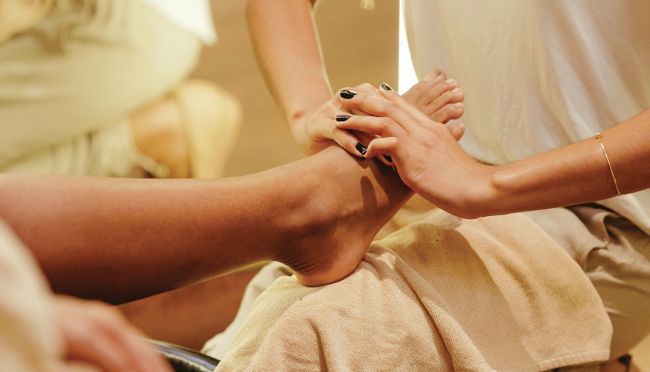
Is a foot massage the same as reflexology?
Not quite. While a foot massage is a lovely component of both treatments, it’s important to recognise that reflexology is far more than massage. During a reflexology session, the therapist works with detailed maps of reflex points, using specific thumb and finger techniques to stimulate these areas. It’s precise, intentional and requires significant training to do safely and effectively.
While a pedicure massage may feel similar, it’s not reflexology unless it’s being delivered by a trained reflexologist. Even then, a reflexologist cannot diagnose conditions that may give rise to any imbalances in the feet.
Can nail technicians offer reflexology?
In the UK, you need a recognised qualification to practice reflexology – and to even begin training, you need a qualification in Anatomy and Physiology (A&P).
A&P gives you the essential understanding of how body systems function: knowledge that is crucial when applying reflexology techniques. Without it, you risk working beyond your professional remit or even causing harm.
This means that nail technicians can’t offer reflexology unless they’ve completed the appropriate training. However, there are still ways to incorporate elements of relaxation and mindfulness into your treatments.
Where do pedicures and reflexology overlap?
Despite their differences, the two treatments share some common ground:
• Relaxation: Both can be incredibly calming and comforting for the client.
• Client care: You’re giving someone focused, hands-on attention – something that always feels good.
• Use of touch: Massage is a key element in both treatments, though applied differently.
• Foot focus: Of course, both are delivered to the feet, often in similar salon settings.
Some suitably qualified therapists, like me, even go on to offer both as complementary services – starting with a cosmetic pedicure and finishing with a reflexology session.
‘‘Nail technicians can’t offer reflexology unless they’ve completed the appropriate training. However, there are still ways to incorporate elements of relaxation and mindfulness into your treatments. ‘‘
How to handle client curiosity
It’s not uncommon for clients to ask for ‘a bit of reflexology’ during a pedicure, especially as awareness of holistic treatments grows. If you’re not trained, a simple, clear explanation goes a long way:
“Reflexology is a specialist therapy that works on pressure points in the feet – it requires its own qualification. I’m not trained in it, but I can offer you a relaxing foot massage as part of your pedicure.”
Clients will appreciate your honesty and professionalism – and you’re bound to build more trust by staying within your scope of practice.
Thinking of upskilling?
If you love the massage element of pedicures and are curious about deeper therapeutic work, reflexology might be a natural next step for you. It can open doors to working more holistically, expand your treatment menu and deepen your understanding of the human body.
As someone who made that journey 15 years ago, I can honestly say it’s one of the most rewarding things I’ve done in my career. It’s a completely different way of connecting with clients – one that goes beyond the surface and supports overall wellbeing.
Your experience as a nail technician gives you a brilliant foundation if you want to consider reflexology training. You already understand the importance of touch, client care and attention to detail, and those are some of the most powerful tools a reflexologist can have.

Do you offer exceptional pedicure services? Don’t forget to enter the
Pedicurist of the Year
category in the
Scratch Stars Awards
2026, before entry closes 15 March. Head to www.scratchmagazine.co.uk/scratchstars for all the details.